
Sky News just dropped a BOMBSHELL that has Ed Miliband reeling! 🏛️🔥 New data proves that importing gas from overseas is actually MORE “dirty” than drilling in our own North Sea!
A major broadcast news investigation has directly challenged the core environmental and economic arguments underpinning the Labour government’s energy policy, exposing a critical flaw in its push to curb North Sea drilling. The analysis, aired by Sky News, presents data suggesting that reliance on imported liquefied natural gas (LNG) may be increasing the UK’s carbon footprint rather than reducing it.
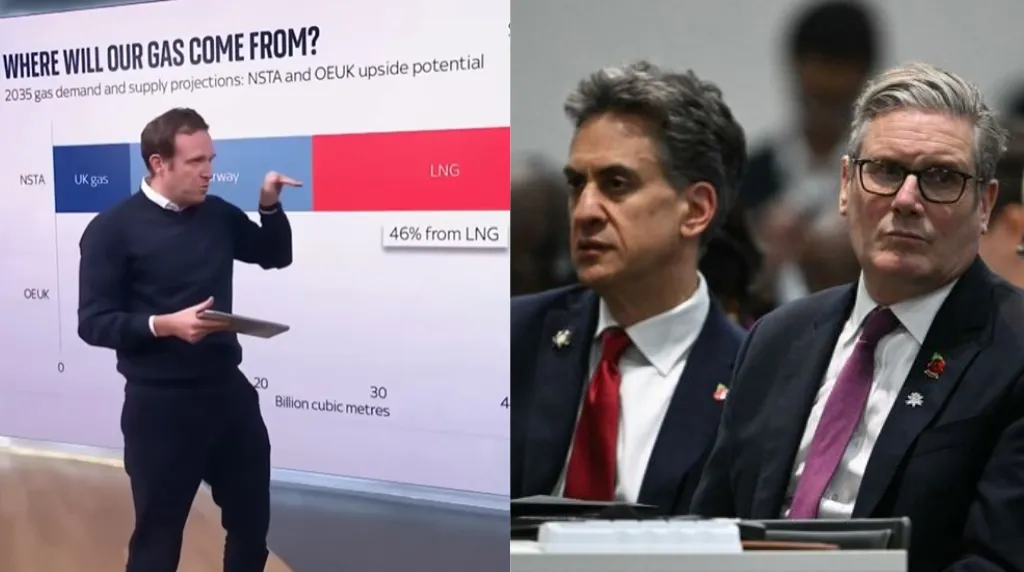
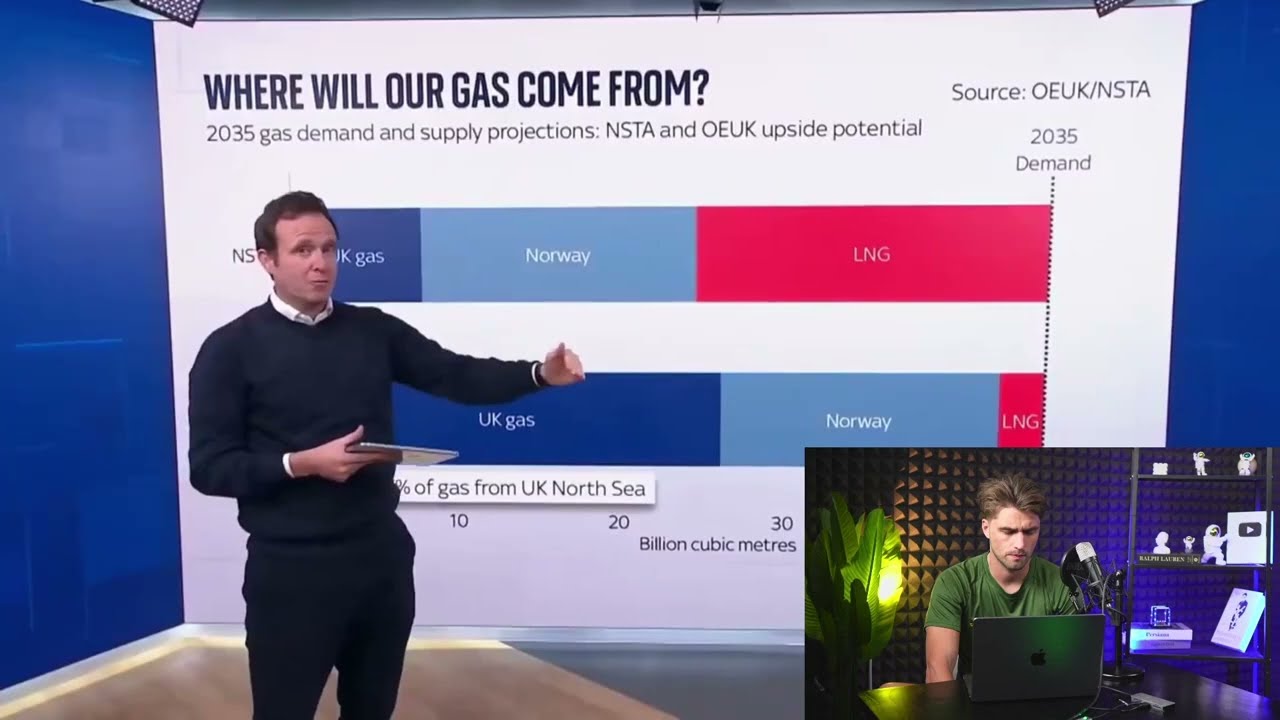
The segment, which has sent shockwaves through political circles, focused on projected energy supply models for the year 2035. Under current government assumptions, domestic UK gas would supply only 18% of national demand, with a staggering 46% coming from imported LNG shipped from nations like Qatar. This heavy import reliance forms a cornerstone of the transition strategy championed by Energy Secretary Ed Miliband.
However, the Sky analysis presented an alternative scenario where reduced overall energy demand combines with sustained domestic production. In this model, the share of gas supplied from the UK North Sea could rise to 57%, with LNG imports plummeting to just 6%. The implications of this shift are profound, touching on national security, cost, and crucially, emissions.
The report highlighted a rarely discussed but critical fact: the process of liquefying natural gas, transporting it across oceans, and regasifying it is inherently carbon-intensive. Current emissions from the UK gas supply are estimated at 27kg per barrel of oil equivalent. A future dominated by long-distance LNG imports would see this figure rise significantly.
Conversely, the analysis argued that gas extracted from the North Sea and piped directly to shore has a substantially lower carbon cost per unit. This leads to the counterintuitive conclusion, now being advanced by industry figures, that increased domestic drilling could result in lower overall emissions from the UK’s gas consumption compared to the import-heavy baseline.
This revelation strikes at the heart of the government’s political narrative on energy and climate. Ministers have consistently framed the move away from new North Sea licenses as a necessary step for meeting net-zero targets and leading on climate action. The Sky data suggests the policy may be having the opposite effect, outsourcing emissions rather than eliminating them.
The fallout is immediate and severe for the Labour leadership. Critics are accusing the government of a catastrophic policy “scam” that has simultaneously raised energy bills, jeopardized supply security, and increased global carbon emissions. There are growing calls for a fundamental policy review and direct accountability for Energy Secretary Ed Miliband.
Political opponents have seized on the report as vindication of their long-held stance. They argue it exposes a deep ideological failure, where the government prioritized symbolic gestures over practical, data-driven solutions that ensure both energy affordability and genuine environmental progress.
The fact that this critique emerged from a mainstream broadcaster like Sky News, rather than partisan outlets, grants it unprecedented weight. It signals a breaking of the established media consensus on the net-zero transition pathway and suggests a new phase of intense scrutiny on the real-world impacts of climate policy.
Energy analysts note the report underscores the complexity of decarbonization. A simplistic “keep it in the ground” approach for domestic fossil fuels ignores the reality of ongoing global demand and the emissions from alternative supply chains. The focus, they argue, must shift to managing the overall carbon budget of energy consumption.
In Westminster, the pressure on Miliband is now palpable. Demands for his dismissal and a public apology are mounting from opposition benches and within segments of the public furious over high energy costs. The government faces a crisis of credibility, needing to either defend its modelling or announce a swift and humiliating policy correction.
This development is more than a political scandal; it is a potential watershed moment for UK energy policy. The established orthodoxy has been challenged with compelling data on a national platform. The government’s response, or lack thereof, will define its competence on the defining issue of energy security and climate change for years to come.
The coming days will test Labour’s unity and strategic agility. Failure to address the fundamental questions raised by this report risks cementing a public perception of a government that is both ideologically rigid and practically inept, with severe consequences for the country’s economic and environmental future.


