
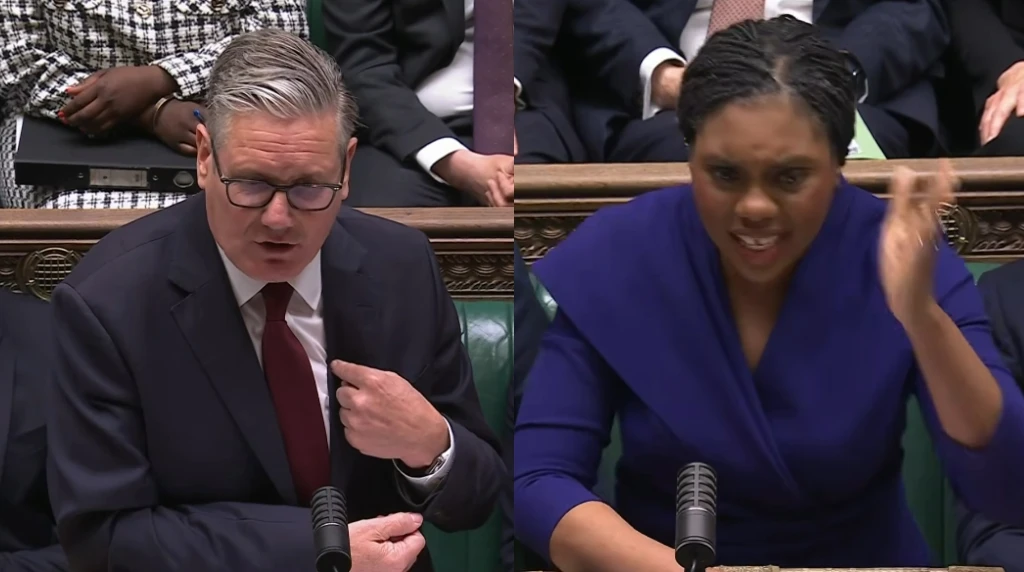
The House of Commons witnessed a deeply contentious Prime Minister’s Questions (PMQs) session today, marking the first major clash between Prime Minister Keir Starmer and Conservative leader Kemi Badenoch since the recent local elections. The debate quickly deteriorated into a hostile exchange surrounding domestic energy security, the future of the North Sea oil industry, and allegations regarding the UK’s stance on Russian oil sanctions.
The Russian Oil Sanctions Controversy
The primary flashpoint of the session centered on explosive accusations from Kemi Badenoch that the Labour government “snuck out an announcement” late last night effectively removing sanctions on Russian oil . Badenoch aggressively questioned the moral and economic logic of the policy, asking the Prime Minister to explain “why oil from Russia is acceptable but oil from Aberdeen is not” .
Prime Minister Starmer strongly rebuked the accusation, dismissing it as a gross misrepresentation of the government’s actions. He clarified that the announcement pertained to a “strong new package of new sanctions going well beyond existing sanctions,” which includes strict bans on maritime services for LNG and refined oil products from Russia .
Starmer defended the use of two targeted, short-term licenses as a standard “phasing-in” mechanism designed to protect UK consumers from immediate market shocks, arguing that similar techniques were employed by the previous Conservative government . He firmly stated, “This is not a question of lifting existing sanctions in any way whatsoever… it is more pressure on Russia”.
Despite this, Badenoch doubled down, claiming that the Prime Minister was “losing his moral compass by backsliding on Ukraine” and citing alleged disagreements from Ukraine’s own sanctions chief regarding the UK’s approach . She notably quipped, “Labour are giving money to Russia, Reform are taking money from Russia, there’s only one party that is standing up to Russia and that is the Conservative Party” .
The Domestic Energy Battle: Renewables vs. North Sea Oil
The international sanctions dispute was intricately tied to a bitter domestic argument over the UK’s energy independence. The Conservative leader fiercely attacked the Labour government’s recent vote to ban new British oil and gas licenses in the North Sea . Badenoch argued that this policy directly harms domestic employment—citing the loss of 1,000 jobs a month in the oil and gas sector—and inadvertently forces the UK to rely more heavily on foreign imports, including Russian energy .
“More people are buying Russian oil because British oil isn’t being drilled. He’s sanctioning British oil but not Russian oil,” Badenoch stated, pressing the Prime Minister on the economic impact on cities heavily reliant on the sector, such as Aberdeen .
Starmer defended the government’s green energy strategy, pointing out that existing North Sea operations are still pumping oil and gas “24/7” and will be supported throughout their lifespans . However, he emphasized that the ultimate solution to volatile energy bills—which fluctuate based on international conflicts in places like Ukraine and Iran—lies in a transition to renewable energy. “The only way to take control is through renewables,” Starmer argued, noting that the government has now consented to renewables capable of powering 23 million households .
A Prime Minister Under Pressure?
Throughout the exchange, the atmosphere was thick with partisan tension. Badenoch repeatedly attacked Starmer’s political standing, painting a picture of a Prime Minister “hanging by a thread” and facing an internal cabinet “fighting to replace him” . She mocked the Prime Minister’s demeanor, accusing him of employing a patronizing tone to mask policy failures and suggesting he was “so deep in the bunker” .
Starmer attempted to deflect the personal attacks by pivoting to his administration’s broader economic and social records. In his closing remarks, he highlighted recent data from the ONS showing the UK has the fastest-growing economy in the G7, the largest drop in NHS waiting lists in 17 years, and better-than-expected inflation figures .
Conclusion
Today’s PMQs laid bare the stark ideological divide between the current Labour government and the Conservative opposition. As global energy markets remain volatile amid the ongoing war in Ukraine, the debate over how the UK balances immediate consumer costs, international sanctions, and the long-term transition to green energy promises to remain a defining, and intensely bitter, political battlefield.


