
A severe wave of public disorder has swept across popular UK beach resorts, sparked by viral social media “link ups” that have drawn thousands of youths to coastal towns during the current heatwave. The ensuing chaos has left local police forces severely overwhelmed and ignited a fierce debate regarding law enforcement tactics, political correctness, and public safety.
The Bournemouth Flashpoint
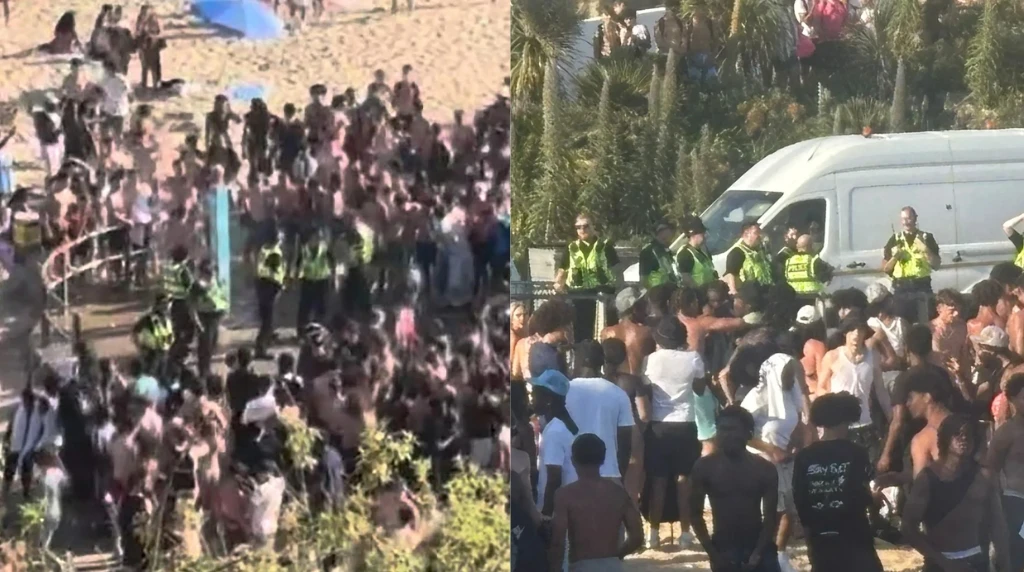
The coastal town of Bournemouth experienced some of the most severe unrest. Footage broadcast by TalkTV captured massive crowds of young people engaging in violent brawls directly on the beach, disrupting families and holidaymakers.
In one particularly harrowing incident captured on video, a mob estimated at roughly 100 youths was seen aggressively chasing a single individual through the crowds, trampling over picnic blankets and windbreaks.
The sheer scale of the flash mob severely strained local resources. Dorset Police were reportedly so overrun by the sudden influx of hostile crowds that they were forced to request emergency assistance from neighboring Hampshire Police. Despite the massive scale of the disorder and the deployment of a heavy police presence, TalkTV reported that only three arrests were officially made in Bournemouth—a statistic that has drawn immediate and intense public backlash.
Operational Failures and the Train Network
Security experts are pointing to systemic intelligence failures as the root cause of the crisis. Speaking on TalkTV, former Metropolitan Police Detective Mike Neville heavily criticized senior police leadership for failing to monitor the social media platforms where these “link ups” are openly organized.
Neville noted that the mobs are predominantly traveling from London via direct train routes to coastal towns like Bournemouth and Southend. He argued that a lack of coordination with the British Transport Police (BTP) allowed the crowds to arrive unimpeded. Neville stated that police should have monitored the rail network, intercepted the groups upon arrival, and preemptively enacted Section 60 orders—which allow for blanket “stop and search” powers for weapons—before the crowds reached the beaches.
The Controversy: Policing, Race, and “Stop and Search”
The law enforcement debate has rapidly become highly politicized. During the broadcast, Neville introduced a controversial demographic angle, explicitly stating that a significant portion of the youths organizing and participating in these specific coastal “link ups” are young black males, referencing promotional posters featuring individuals holding machetes.
Neville accused the media of attempting to cover up this reality by turning off comment sections on news articles, referencing author Douglas Murray’s concept of the “crime of noticing.”
Crucially, the former detective alleged that modern police training is actively paralyzing officers on the ground. He argued that police recruits are taught that aggressive tactics like “stop and search” are inherently racist, leading to a profound hesitance to engage with or preemptively search minority youths, even when organized gang violence is highly likely.
While the TalkTV host pushed back slightly, suggesting the crowds were more diverse, the critique of the police’s ideological paralysis remains the central political takeaway from the incident.
Conclusion
The chaotic scenes in Bournemouth mirror a similar recent “link up” incident in Clapham, London, where a mob of 300 youths terrorized a high street resulting in similarly low arrest numbers. As the summer weather continues, the inability of police to predict, intercept, or adequately prosecute these viral flash mobs is rapidly evolving into a major political crisis for the government and law enforcement leadership.


