
Rupert Lowe Confronts BBC Leadership Over License Fee — A Growing Revolt Over Public Broadcasting
LONDON — A tense parliamentary exchange has reignited one of Britain’s most persistent debates: what exactly should the public be paying for when it funds the BBC? This week, criticism sharpened after Rupert Lowe publicly challenged senior executives over spending, efficiency, and trust — raising questions that now extend far beyond Westminster.
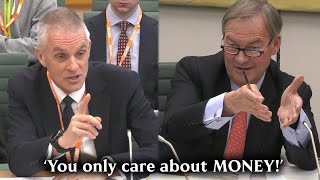
At the center of the controversy is the UK’s television license fee, a mandatory charge that funds the BBC’s operations. Long defended as a cornerstone of independent journalism, the fee is now facing growing resistance as audiences fragment and digital platforms reshape how news is consumed.
During a parliamentary committee hearing, Lowe pressed BBC leadership on what he described as a widening gap between cost and value. Drawing comparisons to leaner digital platforms, he argued that technological change has made traditional models increasingly difficult to justify — particularly when funded by compulsory public payments.
BBC executives, led by Director-General Tim Davie, pushed back firmly. They emphasized that the corporation’s mission extends beyond content volume or efficiency metrics, pointing to its global reporting infrastructure, public service obligations, and commitment to editorial standards. Unlike social media platforms, they argued, the BBC maintains journalists on the ground in conflict zones and politically sensitive regions.
Yet the exchange exposed a deeper tension: whether those traditional strengths still resonate with a rapidly changing audience.

One statistic cited during the hearing captured the shift. Only around half of younger viewers now turn to the BBC for news, a figure that underscores the growing influence of alternative platforms. For critics, that decline signals not just changing habits, but eroding trust — particularly among younger demographics raised in a decentralized media environment.
The BBC disputes that narrative, maintaining that overall trust levels remain relatively high compared to other media institutions. But even within the organization, there is acknowledgment that audience behavior is evolving faster than legacy structures can adapt.
That challenge is compounded by financial pressure. Executives noted that the BBC has already reduced its workforce by thousands in recent years as part of cost-cutting efforts. Still, critics argue that structural reform — not incremental cuts — is what the moment demands.
Lowe’s critique focused heavily on efficiency. He questioned whether increasing budgets or maintaining large staffing levels remains justified in an era defined by digital disruption. His argument reflects a broader skepticism toward large public institutions, particularly those perceived as slow to adapt.
But the debate is not purely economic. It is also political — and cultural.
For some viewers, concerns about bias and editorial direction have become as significant as concerns about cost. While such claims are contested and often polarized, they have contributed to a broader perception gap between the BBC and segments of the public. In a media landscape shaped by personalization and algorithm-driven content, even the perception of imbalance can carry outsized consequences.
At the same time, defenders of the BBC warn that weakening public broadcasting could have long-term consequences for democratic accountability. They argue that the license fee supports not just entertainment, but investigative journalism, regional coverage, and international reporting that commercial outlets may not sustain.
The result is a debate with no easy resolution.

On one side is a model built on universality — the idea that everyone contributes to, and benefits from, a shared public service. On the other is a rapidly fragmenting media ecosystem, where audiences expect choice, flexibility, and often, free access.
The tension between those visions is becoming increasingly difficult to manage.
Adding to the pressure is speculation about the future of the license fee itself. While no immediate overhaul has been announced, policymakers have signaled that alternatives are under consideration, including subscription-based or hybrid funding models. Each option carries trade-offs, from reduced universality to potential political influence over funding decisions.
For now, the BBC remains a central — if contested — institution in British public life. But the tone of the latest parliamentary exchange suggests that patience may be wearing thin.
As Lowe’s questioning made clear, the issue is no longer confined to budgets or programming. It is about legitimacy: whether a publicly funded broadcaster can maintain relevance, trust, and accountability in an era where audiences increasingly look elsewhere.
The answer may determine not only the future of the BBC, but the broader role of public media in the digital age.


